Hyaluronic acid and prolotherapy for fractures: what research shows so far
See what has been studied about hyaluronic acid, prolotherapy, and fracture healing — and what remains uncertain.

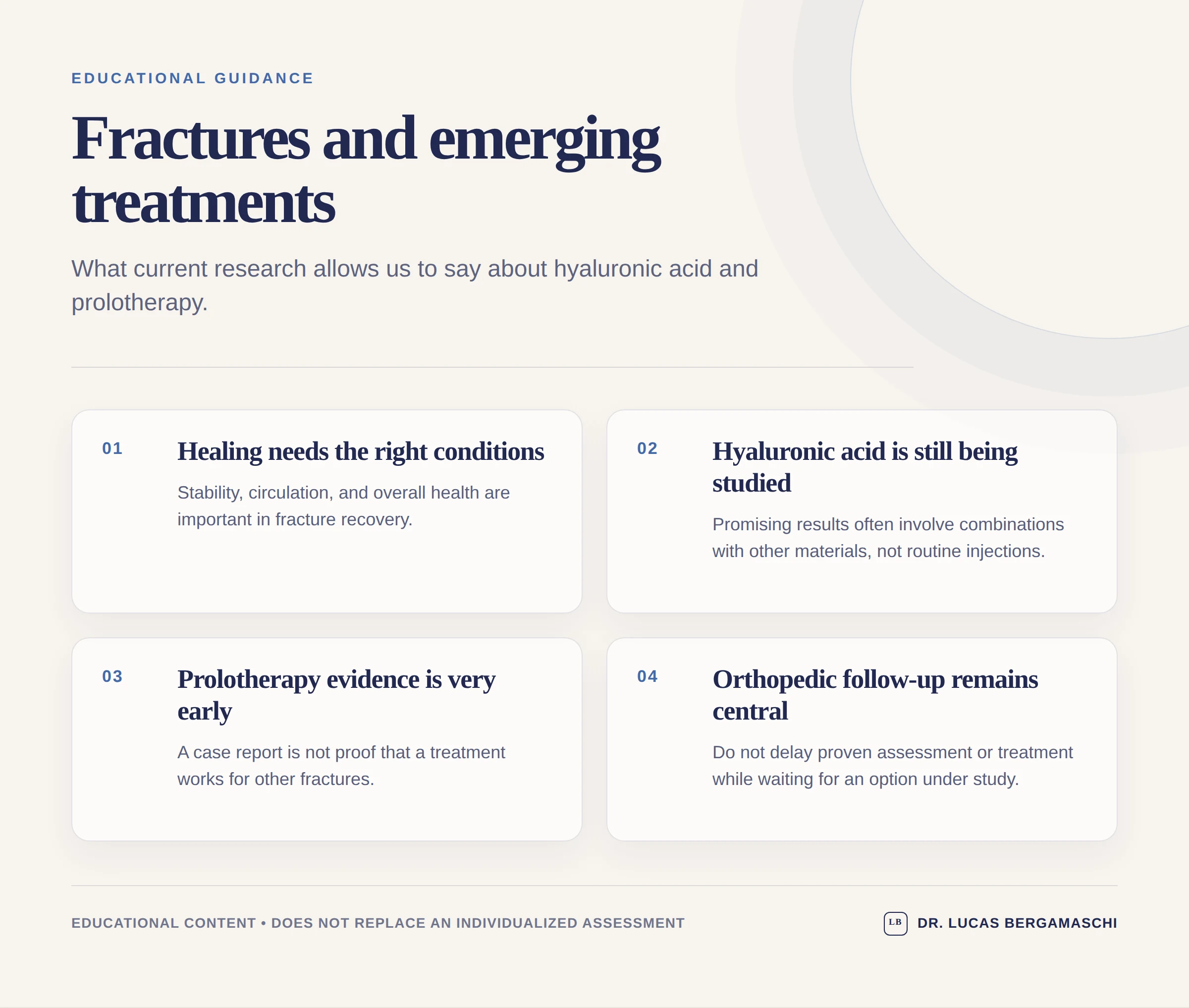
When a bone breaks, the body starts a repair process called bone healing. For it to progress well, more than time is needed: the fracture needs stability, adequate circulation, and general conditions that support recovery. Most fractures progress well with indicated treatment, but some take longer than expected or may not heal properly, which should be assessed by an orthopedic specialist. [1]
In this context, researchers investigate materials and techniques that could support bone formation. Two ideas that draw attention are hyaluronic acid and dextrose prolotherapy. The right question is not whether these methods heal fractures faster, but what has been studied, in which situations, and with what degree of certainty.
Hyaluronic acid: promising, but not routine treatment
Hyaluronic acid is known for use in joints, but it is also being studied as part of biomaterials for bone regeneration. A 2025 systematic review found only nine eligible studies and noted promising results, especially when hyaluronic acid was combined with other materials such as meshes, scaffolds, or grafts. The authors stressed that study designs were very different and that standardized clinical trials are still needed to confirm effectiveness and define how this strategy should be used. [2]
A 2019 retrospective study followed 44 people with atrophic clavicle nonunion treated surgically with plate fixation and autologous bone graft. In some cases, a hyaluronic-acid-based mesh was added. The mesh group had a shorter average time to healing, but the study did not test a simple hyaluronic acid injection and does not show that the substance alone caused the result. [3]
What about dextrose prolotherapy?
Prolotherapy generally uses a glucose solution in local applications. For fractures and nonunion, available evidence is even more preliminary. In 2025, a case report described a 54-year-old man with painful ulnar nonunion after 12 months of conservative treatment. He received five ultrasound-guided applications of 30% dextrose and had radiographic healing at 15 weeks. [5]
This result is interesting, but a case report describes only one person and cannot separate the intervention from individual progression, biological factors, or other care. It is not proof that prolotherapy speeds healing in other fractures or replaces established treatment.
What remains important during fracture recovery
Fracture treatment decisions consider location, break pattern, stability, soft-tissue injury, circulation, infection, and a person's health conditions. In delayed healing or nonunion, investigation may involve imaging and, depending on the situation, factors such as diabetes, smoking, nutrition, and infection. [1] [6]
Established options may include immobilization, reassessing fracture stability, bone stimulation in selected situations, bone grafting, or surgery. The best plan depends on the individual diagnosis; it is not safe to delay a needed assessment while waiting for a technique still under study.
References
- AAOS OrthoInfo: Nonunions
- Fuguet Surroca H, et al. Hyaluronic acid and fracture healing: systematic review
- Kir MÇ. HA-based mesh in atrophic clavicle nonunion
- Açan AE, et al. Hyaluronic acid in a rat fracture model
- Hada S, et al. Dextrose prolotherapy in ulnar nonunion: case report
- Gharu E, et al. Nonunion of fractures: epidemiology and diagnosis
Key points to remember
Visual summary